Natural Remedies for Cough: What Has Evidence
Honey, steam, thyme and salt-water gargles: which natural remedies for cough have research behind them, how to use them, and when to see a doctor.
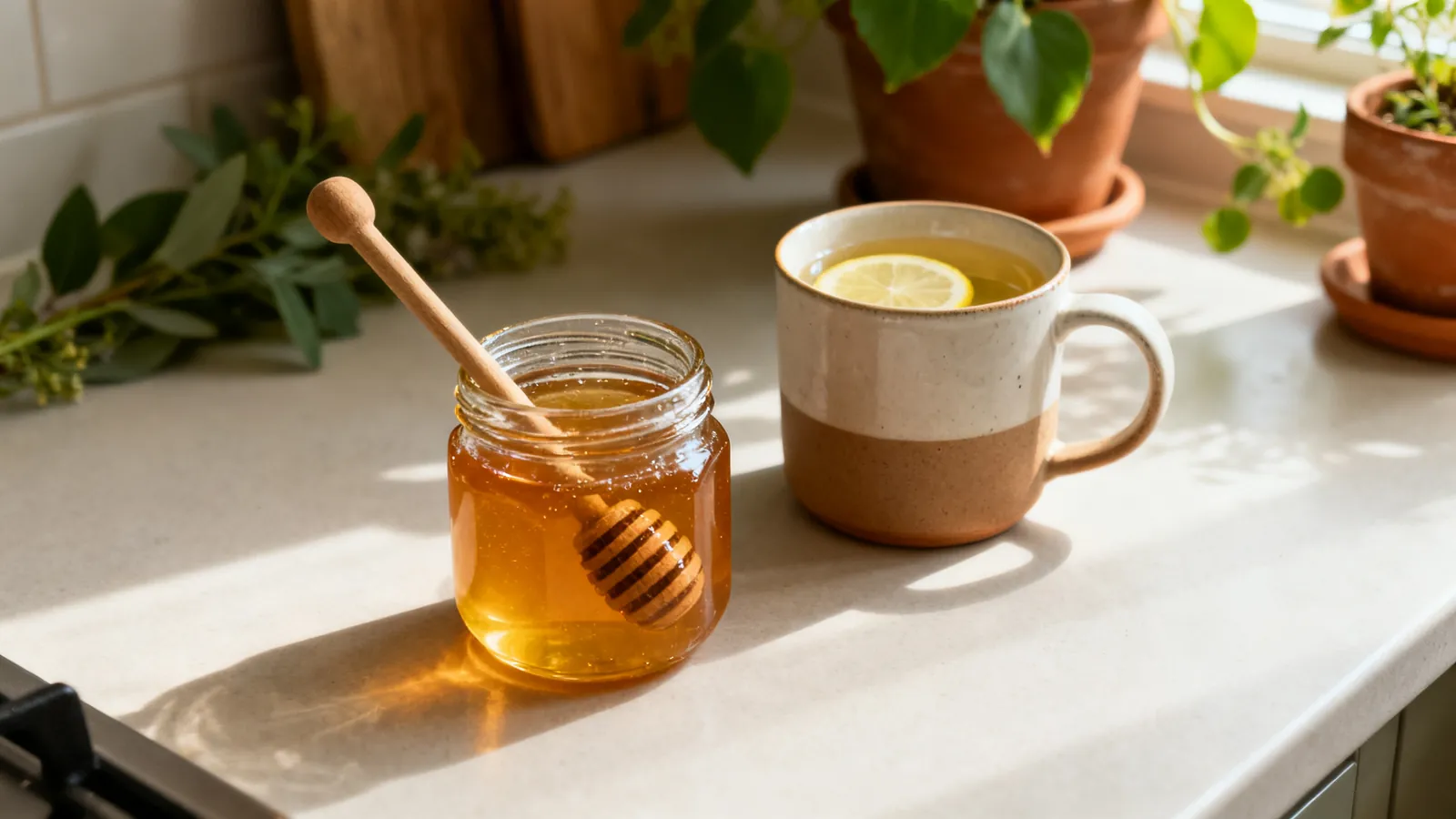
A cough is a reflex, not a disease. Airway nerves react to mucus, irritation or inflammation and trigger a burst of air that clears the passages. Most coughs that follow a cold are viral and settle within one to three weeks. That short window is where home remedies do their work: they do not switch the reflex off, but they can soothe a raw throat, thin mucus and make sleep possible. A smaller group of coughs, including those lasting more than three weeks or arriving with breathlessness or blood, needs a clinician rather than a kitchen.
Which natural remedies for cough have research behind them
The evidence across this field is uneven. A few remedies have been tested in small randomised trials, some have only laboratory or traditional support, and several popular options have been studied and found no better than placebo. Strength of evidence matters more than how long a remedy has been used.
Honey
Honey is the best-studied single remedy for cough. Reviews of trials in children and adults with upper respiratory infection have generally found that a dose at bedtime reduces night-time cough frequency and improves sleep compared with no treatment, and in some trials it performed at least as well as over-the-counter cough syrups. The mechanism is not fully settled; the thick texture coats the throat, and honey’s natural acidity and hydrogen peroxide content may contribute. Evidence is strongest for children over one year and adults with acute viral cough, and weaker for chronic cough.
Thyme and ivy
Thyme has a long history in European cough syrups, and its essential oil contains thymol, which has been studied for relaxant effects on airway smooth muscle. Ivy leaf extracts are a standard ingredient in European herbal cough preparations and have been examined in small trials, mostly in children with acute bronchitis, with some suggestion of reduced cough frequency. The trials are small and often industry-funded, so the results are promising rather than settled. Both are usually taken as liquid extracts or syrups, and both are also common in combination products where the individual contribution is hard to separate.
Warm drinks and steam
Warm fluids are among the oldest recommendations and have modest trial support. Small studies have found that a hot drink can temporarily relieve cough, sore throat and nasal congestion, likely through a combination of hydration, warmth and the soothing effect of sipping. Steam inhalation is more traditional than proven; trials of steam for the common cold have not shown consistent benefit, and there is a real risk of burns, especially in children. A warm shower or a bowl of hot water with the face at a safe distance is the usual approach.
Salt-water gargle
Gargling with warm salt water is a traditional remedy for throat irritation. Small trials suggest it can reduce the sensation of throat pain and may modestly reduce upper respiratory symptoms, though it does not act on the cough reflex itself. It is inexpensive, low-risk and reasonable for adults and older children who can gargle without swallowing.
Sleep position
Propping the head and upper body up with pillows can reduce post-nasal drip irritating the throat at night. This is practical advice rather than a studied intervention, but it is harmless and often helps. For infants, nothing should be placed in the cot; the mattress can be tilted only under medical advice.
What the research does not support
Several widely shared remedies have weak or negative evidence. Vitamin C taken after a cold starts has not consistently shortened cough. Echinacea trials for cold symptoms have been mixed and generally modest. Zinc lozenges have been studied mainly for duration of cold symptoms, with conflicting results and frequent nausea. Menthol ointments on the chest may give a sensation of clearer breathing but do not reduce cough frequency in trials. None of these is dangerous in ordinary use, but none should be relied on as a natural cough suppressant.
How to use these remedies: forms, amounts and timing
Honey
Commonly used amounts in trials are around 2.5 to 10 ml (roughly half a teaspoon to two teaspoons) given at bedtime, either plain or stirred into a warm drink. Some studies used a single dose; others used it up to three times daily. Honey should never be given to infants under one year because of the risk of infant botulism. For adults, a spoonful before sleep is the usual pattern. Raw or pasteurised honey both appear in studies; the form matters less than the dose and timing.
Thyme and ivy preparations
These are usually taken as standardised liquid extracts or syrups following the label. Typical adult doses on labels are 5 to 10 ml of syrup two to three times daily; children’s products have separate age-based directions. Look for a product that lists the plant species and the amount of extract per dose rather than a vague blend. Take them with food if they cause stomach upset.
Warm drinks
Any warm, non-alcoholic drink works: water with lemon, herbal tea, broth. The temperature and the act of sipping matter more than the ingredient. Two or three cups across the day, and one before bed, is a reasonable pattern. Adding honey is optional and adds the benefit described above.
Steam
A hot shower or a bowl of steaming water with the face held at a comfortable distance for five to ten minutes can loosen secretions. Do not add essential oils to the water for children, and never leave a child unattended near hot water. A cool-mist humidifier in the bedroom is a safer alternative for overnight use.
Salt-water gargle
Half a teaspoon of salt in a glass of warm water, gargled for about thirty seconds and spat out, up to three or four times a day. It should not be swallowed, and it is not suitable for children too young to gargle reliably.
Sleeping propped up
Extra pillows or a wedge under the mattress can raise the head of the bed. The aim is a gentle incline, not a sharp angle that causes neck strain.
Side effects, interactions and who should avoid these remedies
Honey is generally well tolerated. It is a sugar source, so people with diabetes should account for it, and it should not be given to infants under one year. Rarely, honey contaminated with certain plant toxins can cause illness; commercial honey is regulated for this.
Thyme and ivy are usually well tolerated at label doses. Thyme may interact with blood-thinning medication in theory, and ivy can cause stomach upset or, uncommonly, allergic reactions in people sensitive to the plant family. Anyone taking prescription medication, pregnant or breastfeeding should speak to a doctor or pharmacist before using herbal cough preparations.
Salt-water gargle is safe for most adults but should not be used by anyone who cannot reliably spit, and frequent use can dry the mouth. Steam carries a burn risk, particularly for children and older adults with reduced sensation. Menthol chest rubs should not be applied to the face or under the nose of infants and young children.
Anyone with asthma, COPD, heart failure or a weakened immune system should check with a clinician before relying on home remedies, because a cough in these groups can signal something that needs treatment.
Common mistakes and what these remedies cannot do
A frequent mistake is treating a cough that has already lasted weeks as if it were a fresh cold. A cough lasting more than three weeks, or one that changes character, needs assessment. Another is doubling up on combination products that contain the same ingredient, or adding honey to an over-the-counter syrup that already contains it. A third is assuming that because something is natural it is safe for everyone; honey for an infant is the clearest example.
These remedies do not cure infections, do not shorten a viral illness and do not replace prescribed treatment for asthma, reflux or other causes of chronic cough. They can make a cough more bearable while it runs its course, and that is a realistic goal.
When a cough needs a doctor, not a remedy
Seek medical advice promptly if any of the following appear: difficulty breathing or breathlessness at rest; coughing up blood; chest pain; a fever that is high or lasting more than a few days; a cough that has lasted more than three weeks; unexplained weight loss or night sweats; a cough that starts suddenly and severely; or a cough in an infant under three months. In children, also watch for noisy or laboured breathing, flaring of the nostrils, ribs pulling in with each breath, drowsiness, or a cough that prevents drinking. A cough that follows a choking episode needs urgent assessment. These signs point to causes that home remedies cannot address.
| Remedy | Form and typical use | Evidence strength | Who should not use it |
|---|---|---|---|
| Honey | 2.5–10 ml at bedtime, plain or in a warm drink | Moderate for acute viral cough in people over one year | Infants under one year; people with diabetes should count the sugar |
| Thyme | Standardised syrup or extract, per label, 2–3 times daily | Limited, small trials | People on blood thinners should ask a pharmacist; allergy to the plant family |
| Ivy | Standardised syrup or extract, per label, 2–3 times daily | Limited, small trials, some industry-funded | Allergy to ivy; stomach upset is possible |
| Warm drinks | 2–3 cups daily, one at bedtime | Modest, short-term relief | No specific group, aside from fluid restrictions |
| Steam | 5–10 minutes, or a humidifier overnight | Weak for cough; traditional | Children unsupervised near hot water; burns risk |
| Salt-water gargle | Half a teaspoon in warm water, up to 3–4 times daily | Modest for throat pain | Anyone who cannot spit; young children |
| Propped sleeping | Extra pillows or a wedge | Practical, not trial-tested | Infants should not have pillows in the cot |
Questions people ask about natural cough remedies
Do natural remedies for cough actually work?
Some do, modestly. Honey has the best supporting evidence for reducing night-time cough in acute viral illness. Thyme and ivy have small trials suggesting benefit, and warm drinks give short-term relief. None of them cures an infection or replaces treatment for an underlying condition.
Is honey a natural cough suppressant?
Honey is the most studied home remedy for cough and has performed at least as well as some over-the-counter syrups in small trials. It soothes the throat and may reduce cough frequency at night. It must never be given to infants under one year.
How long should a cough last before seeing a doctor?
Most viral coughs settle within one to three weeks. A cough lasting more than three weeks, or one with breathlessness, blood, chest pain or persistent fever, should be assessed by a clinician rather than managed at home.
Can children use these remedies?
Honey is suitable for children over one year, in the amounts used in studies. Thyme and ivy syrups have children’s formulations with age-based directions on the label. Steam and salt-water gargle are not suitable for young children because of burn and choking risks. Check with a paediatrician before giving any herbal preparation to a child.
What is the safest way to use steam for a cough?
A hot shower or a bowl of steaming water with the face at a safe distance for five to ten minutes is the usual approach. A cool-mist humidifier overnight is safer than boiling water, especially where children are present. Essential oils should not be added to steam for children.
Common questions
Do natural remedies for cough actually work?
Some do, modestly. Honey has the best supporting evidence for reducing night-time cough in acute viral illness. Thyme and ivy have small trials suggesting benefit, and warm drinks give short-term relief. None of them cures an infection or replaces treatment for an underlying condition.
Is honey a natural cough suppressant?
Honey is the most studied home remedy for cough and has performed at least as well as some over-the-counter syrups in small trials. It soothes the throat and may reduce cough frequency at night. It must never be given to infants under one year.
How long should a cough last before seeing a doctor?
Most viral coughs settle within one to three weeks. A cough lasting more than three weeks, or one with breathlessness, blood, chest pain or persistent fever, should be assessed by a clinician rather than managed at home.
Can children use these remedies?
Honey is suitable for children over one year, in the amounts used in studies. Thyme and ivy syrups have children's formulations with age-based directions on the label. Steam and salt-water gargle are not suitable for young children because of burn and choking risks. Check with a paediatrician before giving any herbal preparation to a child.
What is the safest way to use steam for a cough?
A hot shower or a bowl of steaming water with the face at a safe distance for five to ten minutes is the usual approach. A cool-mist humidifier overnight is safer than boiling water, especially where children are present. Essential oils should not be added to steam for children.
Read next

Natural Remedies for Allergies: What Helps Hay Fever
Natural remedies for allergies: saline rinses, butterbur, quercetin, exposure control and the local honey myth, plus when hay fever needs a doctor.
Natural Remedies for Headaches: What Works, What Doesn't
Explore natural remedies for headaches, from hydration to peppermint oil. Learn what research supports and the warning signs that need a doctor.

Natural Remedies for Acid Reflux and Heartburn
A calm guide to natural remedies for acid reflux and heartburn: what research says about ginger, chamomile, alginate, plus warning signs to see a doctor.