Greens Powders: What's Inside and Who They Suit
Greens powders blend grasses, algae and vegetable powders. Learn what the research says, how to read a label, and who should avoid them.
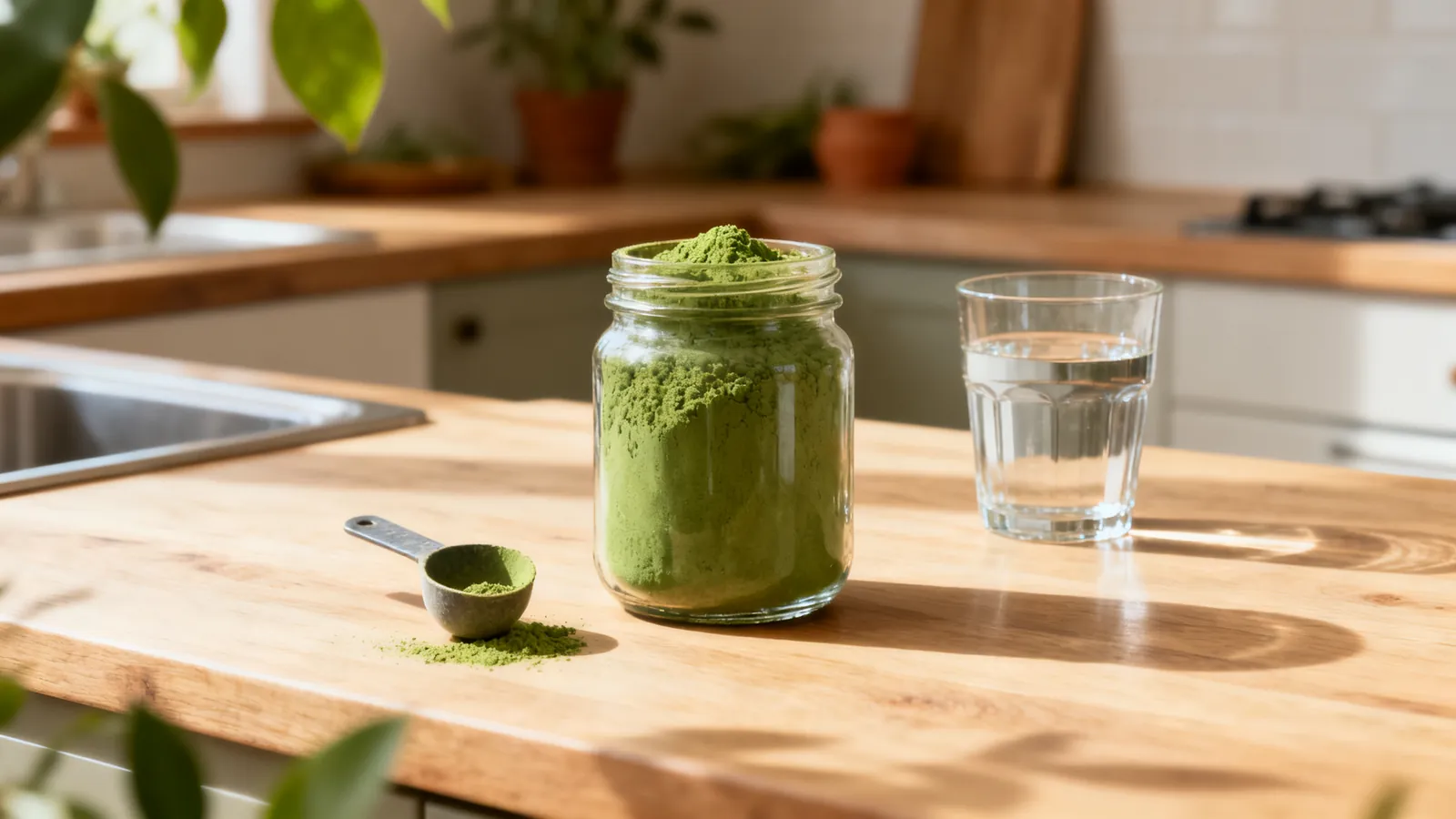
Greens powders are finely milled blends of dried plant material, usually mixed with water or juice and drunk as a supplement. A typical scoop might contain powdered wheatgrass, barley grass, spirulina, chlorella, spinach, kale, broccoli, beetroot, plus added probiotics, digestive enzymes, flavourings and a multivitamin-style top-up of vitamins and minerals. They are sold as a convenient way to add plant foods to a diet that may be short on vegetables. That is a reasonable description of what they are. It is not the same as eating vegetables, and the research on health outcomes is thin.
The category is broad. Some products are mostly grass powders with a little flavouring. Others are closer to a multivitamin with a small amount of plant powder for colour. The label is the only reliable guide, and it is often written to obscure rather than reveal. This guide explains what is usually in a greens powder, what the evidence does and does not support, how to use one sensibly, and who should skip them.
What is actually in a greens powder
Most greens powders are built from a handful of categories:
- Cereal grasses. Wheatgrass, barley grass, oat grass and alfalfa. These are the young leaves of the plant, dried and milled. They contain chlorophyll, some fibre, small amounts of vitamins and minerals, and a range of plant compounds. Wheatgrass and barley grass are gluten-free at the leaf stage, though people with coeliac disease should check because some products are grown alongside wheat grain.
- Algae. Spirulina and chlorella are blue-green and green algae, high in protein for a plant, with iron, B vitamins and chlorophyll. They are also the ingredients most often linked to contamination concerns.
- Vegetable and fruit powders. Spinach, kale, broccoli, beetroot, carrot, berry and others, dried and milled. These contribute some vitamins, minerals and polyphenols, but the amounts are usually small compared with a whole serving of the fresh vegetable.
- Probiotics and enzymes. Added live cultures and digestive enzymes. The evidence for digestive benefit from these in a powder is mixed, and the strains and doses are often not stated clearly.
- Added vitamins and minerals. Many products are fortified to make the label look stronger. This is where a greens powder can start to resemble a multivitamin.
- Flavourings, sweeteners and fillers. To make the powder drinkable. These can include natural flavours, stevia, monk fruit, maltodextrin or inulin.
A recurring problem is the proprietary blend. Instead of listing how much of each ingredient is present, the label gives a total weight for a blend of many ingredients. A product might say “Greens Blend 5 g” and list twenty plants underneath. That tells you nothing about how much of each one you are getting. It may be a meaningful amount of the first ingredient and a dusting of the rest.
What the research shows, and where it stops
The honest summary is that greens powders have been studied far less than their marketing suggests. Most research has looked at individual ingredients, not at the finished powders.
- Spirulina and chlorella have been studied in small trials for cholesterol, blood pressure and blood sugar. Some results are encouraging, but the trials are small, often short, and sometimes of poor quality. The evidence is not strong enough to say they treat or prevent any condition.
- Wheatgrass and barley grass have been studied for antioxidant activity and for symptoms in conditions such as ulcerative colitis, again in small trials. The results are mixed and the studies are few.
- Vegetable and fruit powders have been compared with whole vegetables in a small number of studies. The general finding is that they do not deliver the same range of fibre and plant compounds as the whole food, and they do not replace a serving of vegetables.
- Probiotics in powders have a large research literature, but the effects are strain-specific and dose-specific. A greens powder rarely states which strains or how many live organisms it contains at the end of shelf life.
What the research does not show is that a greens powder prevents disease, detoxifies the body, or makes up for a poor diet. There is no good evidence that they extend life or reduce the risk of chronic disease. Reviews of the research generally conclude that the evidence is limited and that whole foods remain the better choice.
How to use a greens powder
If you decide to use one, the practical points are simple.
Forms. Greens powders come as loose powder in tubs, single-serve sachets, capsules and sometimes as a liquid concentrate. Loose powder is the most common and the cheapest per serving. Capsules are convenient but you may need several to equal a scoop.
Amounts. There is no standard dose. Labels usually suggest one scoop or one teaspoon a day, mixed with water or juice. Studies on individual ingredients such as spirulina have commonly used 1–3 g a day, and some have used up to 10 g, but that is for the isolated ingredient, not for a blended greens powder. Follow the label and do not exceed it.
Timing. Most people take it in the morning, with or without food. There is no strong evidence that timing matters. Some people find it easier on the stomach with food.
What to look for on a label.
- A full ingredient list with amounts per serving, not just a proprietary blend.
- A named manufacturer and a batch number.
- Third-party testing for heavy metals, ideally from a recognised laboratory. Look for a certificate of analysis or a statement that the product is tested for lead, cadmium, arsenic and mercury.
- For probiotics, the strain names and the colony-forming units at end of shelf life, not at time of manufacture.
- A clear statement of any allergens, including gluten, soy or dairy.
- No more than a sensible amount of added vitamins. A greens powder plus a multivitamin can push some nutrients well above what you need.
How to take it. Mix with water, juice or a smoothie. Some people add it to yoghurt or oats. Start with half a scoop to see how your digestion responds. Store it as directed, usually cool and dry, and use it within the time stated after opening.
Side effects, interactions and who should avoid it
Greens powders are generally well tolerated, but they are not risk-free.
Digestive effects. Bloating, gas, loose stools or constipation are the most common complaints. Fibre, inulin, probiotics and algae can all cause them, especially in the first week.
Vitamin K and blood thinners. Many greens powders contain kale, spinach, parsley, broccoli and other dark leafy greens, which are rich in vitamin K. Vitamin K can interfere with warfarin and similar anticoagulants. If you take a blood thinner, do not start a greens powder without speaking to your prescriber. The concern is not the vitamin K itself but a sudden change in intake.
Iodine and thyroid. Spirulina, chlorella and kelp are sources of iodine. For people with thyroid disease, especially those on thyroid medication or with autoimmune thyroid conditions, a sudden iodine load can be a problem. Check with your doctor.
Heavy metals. Algae and some plant powders can take up heavy metals from water and soil. Lead, cadmium, arsenic and mercury have been found in some greens powders in testing. This is why third-party testing matters. Products grown in contaminated water are a particular concern. No brand is named here, but the issue is real and has been reported in independent testing.
Medication interactions. Beyond warfarin, greens powders can interact with thyroid medication, diabetes medication and immunosuppressants. The fibre and probiotics can also affect how some drugs are absorbed. Take any supplement at least two hours apart from medication unless your pharmacist says otherwise.
Who should avoid them.
- Anyone taking warfarin or another vitamin K antagonist.
- People with thyroid disease, unless cleared by a doctor.
- People with kidney disease, because of potassium and other minerals.
- People with autoimmune conditions on immunosuppressants.
- Pregnant or breastfeeding women, unless a doctor or midwife approves.
- Children, unless a paediatrician recommends it.
- Anyone with a known allergy to any ingredient, including algae, grasses or added probiotics.
If you take any prescription medication, are pregnant or breastfeeding, or have a medical condition, speak to a doctor or pharmacist before starting a greens powder. Do not stop or change prescribed medication on your own.
Common mistakes and what greens powder cannot do
It cannot replace vegetables. A scoop of powder does not provide the fibre, water, volume and full range of plant compounds of a bowl of vegetables. It is a supplement, not a substitute.
It is not a detox. The body detoxifies itself through the liver and kidneys. No powder is needed for that, and none has been shown to speed it up.
More is not better. Taking several scoops a day does not improve results and may increase the risk of digestive upset or excessive vitamin intake.
A proprietary blend is a warning sign. If the label does not tell you how much of each ingredient is present, you cannot judge whether the product is worth taking.
Greens powders are not a weight-loss product. Some are marketed for weight loss, but there is no good evidence that they cause meaningful weight loss on their own.
They are not a substitute for a multivitamin if you need one. If a doctor has recommended a specific vitamin or mineral, a greens powder is unlikely to provide it in the right amount.
Comparing forms and options
| Option | What it is | Evidence | Who it does not suit |
|---|---|---|---|
| Greens powder blend | Dried grasses, algae, vegetable powders, sometimes probiotics and added vitamins | Limited; mostly studies on individual ingredients, not blends | People on warfarin, thyroid disease, kidney disease, pregnant or breastfeeding, children |
| Spirulina or chlorella alone | Single-ingredient algae powder or tablet | Small trials for cholesterol, blood pressure, blood sugar; evidence mixed | People with iodine sensitivity, thyroid disease, autoimmune conditions |
| Wheatgrass or barley grass powder | Single-ingredient cereal grass powder | Small trials for antioxidant activity and some digestive symptoms; evidence limited | People with coeliac disease should check for gluten cross-contamination |
| Whole vegetables and fruit | Fresh, frozen or cooked produce | Strong evidence for health benefits | No one, unless medically restricted |
| Multivitamin | Isolated vitamins and minerals | Useful for specific deficiencies; not a substitute for food | People who already get enough from diet; risk of excess with added greens powder |
Reading the label: a short checklist
- Does the label give amounts for each ingredient, or hide them in a blend?
- Is there a batch number and a manufacturer name?
- Is there a statement about heavy-metal testing?
- Are probiotic strains and CFU counts stated at end of shelf life?
- Are allergens clearly listed?
- Does the vitamin content overlap with other supplements you take?
- Is the product suitable for your medications and health conditions?
If the answer to several of these is no, the product is not worth the money. A greens powder can be a convenient addition to a diet that is already varied, but it is not a shortcut to health, and it is not risk-free. Talk to a doctor or pharmacist before starting one, especially if you take medication, are pregnant or breastfeeding, or have a medical condition.
Common questions
What is the best greens powder?
There is no single best product. Look for one that lists amounts for each ingredient rather than a proprietary blend, states third-party heavy-metal testing, and does not overload you with added vitamins. The right choice depends on your diet, medications and health conditions. Speak to a doctor or pharmacist if you take any prescription medication.
Are greens powders worth it?
They can be a convenient way to add some plant compounds to your diet, but the evidence that they improve health outcomes is limited. They do not replace vegetables and are not a substitute for a varied diet. If you already eat plenty of vegetables, a greens powder adds little.
Can greens powder replace vegetables?
No. A scoop of powder does not provide the fibre, water, volume and full range of nutrients of a serving of whole vegetables. It is a supplement, not a replacement. Use it alongside vegetables, not instead of them.
Who should not take greens powder?
People taking warfarin or similar blood thinners should avoid them because of vitamin K. People with thyroid disease, kidney disease, autoimmune conditions on immunosuppressants, pregnant or breastfeeding women, and children should only take them if a doctor approves. Always check with a doctor or pharmacist first.
Do greens powders have heavy metals?
Some have been found to contain lead, cadmium, arsenic and mercury in independent testing. Algae and plant powders can take up heavy metals from soil and water. Choose products that state third-party testing for heavy metals and provide a certificate of analysis.
Read next
Acai Berry: Nutrition, Bowls and Weight Loss Claims
Acai berry explained: what the fruit contains, how it is sold as puree or powder, what research suggests, the sugar in bowls, and who should avoid it.
Chlorella vs Spirulina: What the Evidence Says
Chlorella and spirulina are both green algae powders, but they differ in cell wall, nutrients, and evidence. Learn forms, amounts, and safety.
Goji Berry: Benefits, Uses and Who Should Avoid It
A calm reference on goji berries: what dried goji contains, how they are eaten, what eye-health research suggests, and the warfarin and nightshade cautions.